
Stores and delivery certification
Store Clerk and Delivery Seller
Selling beer, wine and spirits to go: ID at the register, adults buying for minors, intoxicated customers, deliveries, and the penalties.
Study guide
1The two sales you refuse
A store that sells alcohol to go follows the same two rules as a bar. No sale to a person under 21. No sale to a person who is visibly intoxicated. In New York both are in Alcoholic Beverage Control Law section 65, and they apply to every license type, from a liquor store to a gas station cooler.
The customer does not drink in front of you, so you have less time and less to go on. Use what you have: how the customer walks in, how they speak at the counter, the smell of alcohol, trouble counting money or working the card reader. If the signs are there, the sale is refused, including beer.
In New York a person must be at least 18 to sell alcohol at a register. A store may refuse any sale, as long as the reason is not discrimination against a protected group. A lost sale costs a few dollars. A sale to a minor can cost the license.
Know this for the exam
- No sale under 21. No sale to a visibly intoxicated customer.
- The rules cover beer in a grocery the same as spirits in a liquor store.
- Watch the walk, the speech and the hands.
- You may refuse any sale that is not discrimination.
2ID at the register
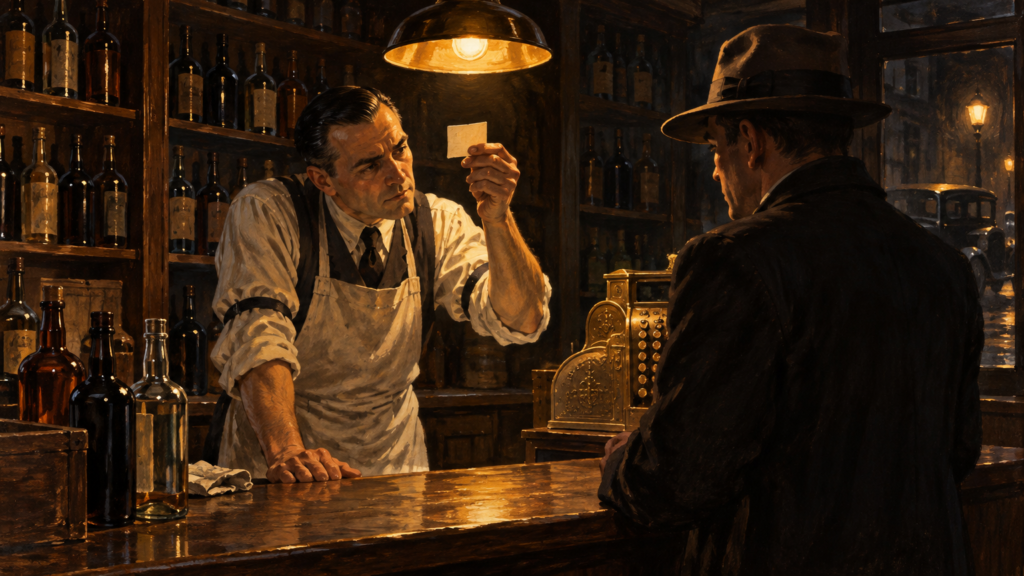
Card everyone who looks under 30, every time, including regulars. Ask the customer to take the ID out of the wallet and hand it to you. Check the type of ID, the expiration date, the birth date and the photo.
In New York the acceptable forms are a valid driver's license or non-driver ID from a US state, the federal government, a US territory or a Canadian province, a valid passport from any country, and a US military ID. A college ID, a birth certificate, a credit card with a photo or a picture of a license on a phone is not acceptable. An expired ID is not valid.
Do the date math yourself. Take today's date and subtract 21 years. A customer born after that date is under 21, even by one day. Many registers ask for the birth date, and a scanner check is a recognized defense in New York, but the register only knows what you type and a scanner cannot see the face. A person who is carded and has no ID does not get the sale.
Know this for the exam
- Card anyone who looks under 30, regulars included.
- Type, expiration, birth date, photo.
- Today minus 21 years is the cutoff.
- No ID means no sale.
3Adults buying for minors
The most common way minors get alcohol from a store is an adult who buys it for them. This is called a third-party or straw purchase. If you have reason to believe the alcohol is for a minor, you refuse the sale to the adult.
Watch for the signs. A group of young people waits outside or in a car while one older person comes in. A minor picks the product and an adult carries it to the counter. Money changes hands in the parking lot. An adult who was just refused comes back with a different person. A customer buys a large amount of the sweet, cheap products teenagers favor.
When a group comes to the counter together and the alcohol is plainly for all of them, ask every person in the group for ID. If one cannot show valid proof of age, refuse the whole sale. Explain the rule once, stay polite, and call a manager if the customer argues.
Know this for the exam
- Refuse a sale you believe is for a minor, even when the buyer is of age.
- Watch the door, the parking lot and who chose the product.
- Card the whole group when the purchase is shared.
- Stay polite. Get a manager if it turns into an argument.
4Delivery, penalties and records
Delivery does not change the rules. The person who hands over the alcohol checks ID at the door and confirms the recipient is 21 and not visibly intoxicated. Alcohol is never left on a porch or with a minor who answers the door. If there is no valid ID, the order goes back to the store.
The penalties fall on the clerk as well as the store. In New York, selling or giving alcohol to a person under 21 is unlawfully dealing with a child under Penal Law section 260.20, a class A misdemeanor. The State Liquor Authority can fine the license up to $10,000 for a violation, suspend it or revoke it. Police and the Authority run underage decoy operations, and a decoy looks like any other young customer.
Civil liability applies to stores too. New York's Dram Shop Act, General Obligations Law section 11-101, covers any unlawful sale to an intoxicated person that leads to injury, and section 11-100 covers knowingly furnishing alcohol to a person under 21. Keep a refusal log by the register. Write the date, the time, what was refused and why. It shows a pattern of care if the store is ever questioned.
Know this for the exam
- Delivery: check ID at the door. Never leave alcohol unattended.
- Selling to a minor is a class A misdemeanor for the clerk in New York.
- License fines run up to $10,000 per violation, plus suspension or revocation.
- Decoy checks are routine. Keep a refusal log.
Practice in the game
The same rules, under pressure. Play Counter Check before you sit the exam.
Final exam
12 questions drawn at random. You need 10 correct to pass. Every answer is explained when you finish, and you can retake the exam with a fresh set of questions.
Mark every lesson complete to unlock the exam.
Proof & Peril certificates record that you completed a course and passed its exam. They are training credentials. They are not a government license, a TTB permit, or a state-approved alcohol server certification, and the courses are education, not legal advice. Producer courses cover United States federal rules. Service courses teach responsible service with New York examples, and the rules of your own state control.