
Bartenders certification
Responsible Bartending
Checking ID, counting drinks, reading the signs of intoxication, cutting a guest off, and what the law does to the person who poured.
Study guide
1Who you may not serve
Every state bars the same two sales: alcohol to a person under 21, and alcohol to a person who is visibly intoxicated. In New York both are in Alcoholic Beverage Control Law section 65. The law covers selling, delivering and giving away, so a free drink counts.
You are also responsible for what happens after the pour. If an adult buys a round and hands one glass to a 19 year old at your bar, the drink reached a minor on your premises. Watch where the drinks go, not only who paid.
In New York a licensee may not serve a minor even when a parent is at the table and says it is fine. You may also refuse any guest for any reason that is not discrimination against a protected group. Nobody has a right to be served a drink.
Know this for the exam
- No service under 21. No service to a visibly intoxicated person.
- Free drinks and drinks passed along by a friend count.
- In New York a parent's permission does not let a bar serve a minor.
- You may refuse service. You may not discriminate.
2Checking ID at the bar
Ask for ID from anyone who looks under 30. Take the ID in your hand. Check four things in order: the type of ID, the expiration date, the date of birth, and the photo against the face in front of you.
New York names the ID a licensee may rely on: a valid driver's license or non-driver ID from a US state, the federal government, a US territory or a Canadian province, a valid passport from any country, and a US military ID. A college ID, a work badge, a birth certificate or a photo of a license on a phone is not on the list. An expired ID is not valid.
An under-21 license is often printed vertically. The holder may have turned 21 since it was issued, so read the birth date and do the math. To do the math fast, take today's date and subtract 21 years. Anyone born on or before that date is old enough. If anything is off, ask a question only the real holder would answer quickly, such as the zip code or middle name, and refuse if you are still unsure.
Know this for the exam
- Card anyone who looks under 30. Hold the ID.
- Type, expiration, birth date, photo.
- Not acceptable: college ID, expired ID, a picture on a phone.
- Today minus 21 years. Born on or before that date is 21.
- When in doubt, refuse.
3Counting drinks and reading the guest
A standard drink is 12 ounces of 5% beer, 5 ounces of 12% wine, or 1.5 ounces of 80 proof spirits. Each holds about the same amount of alcohol. A double is two drinks. A strong cocktail with three spirits can be three. Count standard drinks, not glasses.
The body clears roughly one standard drink an hour. Coffee, food, water and fresh air do not speed that up. Food before or during drinking slows how fast alcohol is absorbed, which is why it helps to offer it early. Only time lowers a person's blood alcohol.
Watch for change. The usual signs are slurred or loud speech, slow answers, glassy eyes, swaying, stumbling, spilling, fumbling with money, mood swings, and ordering faster. One sign may mean nothing. Several signs together, or a clear change since the guest arrived, mean the guest is visibly intoxicated and service stops.
Know this for the exam
- 12 oz beer, 5 oz wine, 1.5 oz spirits are each one drink.
- About one drink an hour leaves the body. Only time works.
- Look for several signs together and for change over the visit.
- Visibly intoxicated means service stops.
4Cutting off, and what is at stake
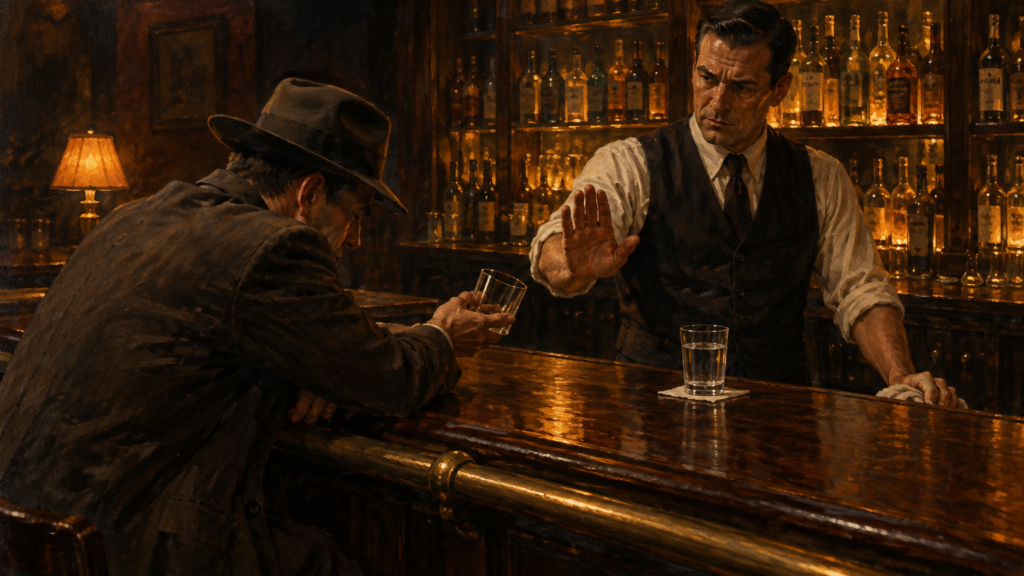
Cut off early and calmly. Speak quietly, away from the guest's friends if you can. Say what you are doing, not what you think of the guest: I can't serve you another drink tonight. Offer water, food and a ride. Do not argue, bargain or serve one last drink. Tell your manager and the other bartenders so the guest is not served by someone else, and write it in the incident log.
The stakes are personal. In New York, giving or selling alcohol to a person under 21 is unlawfully dealing with a child under Penal Law section 260.20, a class A misdemeanor charged against the person who served. The State Liquor Authority can fine the license up to $10,000 for a violation, suspend it or revoke it.
There is civil liability too. Under New York's Dram Shop Act, General Obligations Law section 11-101, a person injured by an intoxicated guest can sue the business that unlawfully served that guest. Section 11-100 adds liability for knowingly furnishing alcohol to a person under 21. A written log made the same night is the best evidence that you did your job.
Know this for the exam
- Be calm, private and firm. No last drink.
- Offer water, food and a ride. Tell the team. Log it.
- Serving a minor in New York is a class A misdemeanor for the server.
- Dram shop law lets injured third parties sue the business.
Practice in the game
The same rules, under pressure. Play Cut Off before you sit the exam.
Final exam
12 questions drawn at random. You need 10 correct to pass. Every answer is explained when you finish, and you can retake the exam with a fresh set of questions.
Mark every lesson complete to unlock the exam.
Proof & Peril certificates record that you completed a course and passed its exam. They are training credentials. They are not a government license, a TTB permit, or a state-approved alcohol server certification, and the courses are education, not legal advice. Producer courses cover United States federal rules. Service courses teach responsible service with New York examples, and the rules of your own state control.